
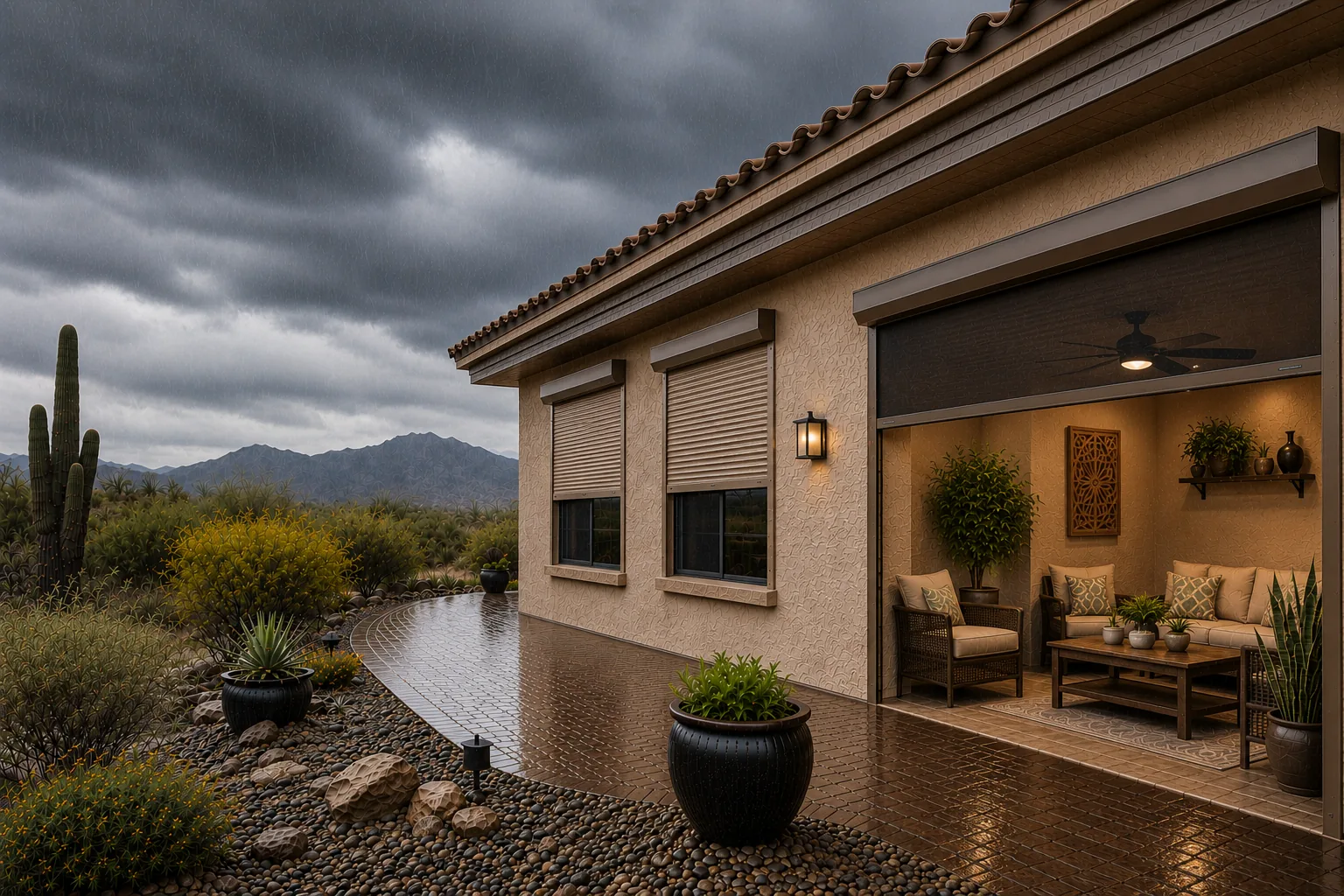
Metro Phoenix Monsoon And Dust Protection
Monsoon and dust protection for Metro Phoenix homes
Monsoon season runs June 15 through September 30 every year, and blowing dust, wind-driven debris, and driving rain all look for the same way into your home: the openings. Windows, doors, sliders, and patios take the hit while the walls around them do nothing.
Roll-A-Shield has manufactured rolling shutters in Arizona since 1979 and fits motorized rolling screens across the Valley, both sized to the exact openings that need covering and installed by our own Metro Phoenix crews.

Monsoon Basics
What does monsoon season do to a Phoenix home, and what actually stops it?
Arizona monsoon season officially begins June 15 and runs through September 30, as defined by the National Weather Service, and July and August are typically the most intense months for storm activity in the Phoenix area. The damage path is almost always an opening rather than a wall: fine desert dust reaches the window frame and gets into the house through anything left uncovered, wind carries gravel and broken branches against glass, and driving rain finds cracked windows, dried-out seals, and sliders that are not fully latched.
A barrier mounted outside the opening meets all of it before it reaches the glass or the frame. Shutters and screens do different jobs here, and the rest of this page sorts out which opening needs which.
Local. Experienced. Trusted.
Proudly manufacturing in Phoenix, AZ since 1979. Thousands of homeowners and businesses across Metro Phoenix trust Roll-A-Shield to protect what matters most.
What Monsoon Season Sends At Your Openings
Four things that get in, and where they get in
Every one of these arrives at the same place. Not the roof, not the walls, but the openings you can see through.
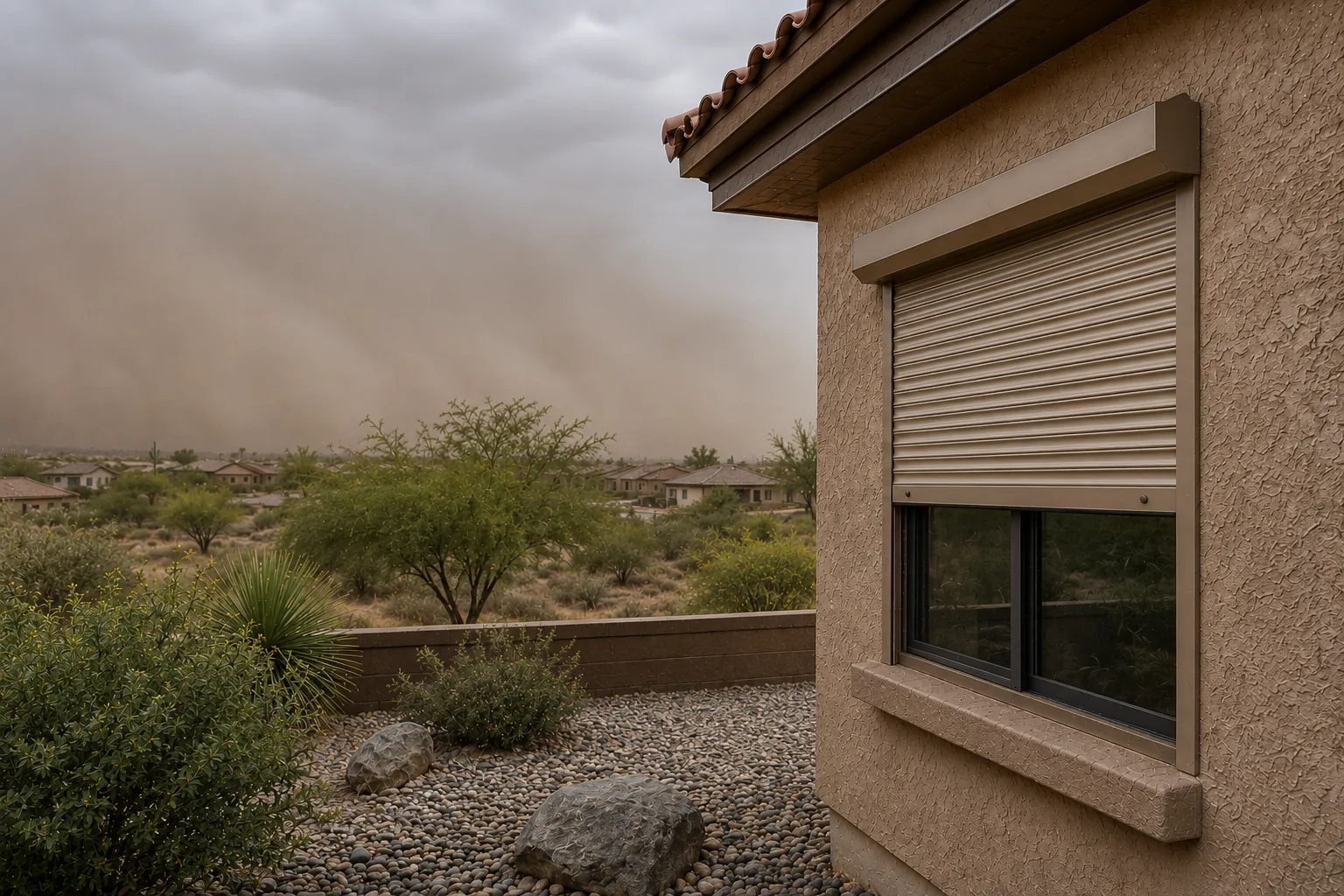
Blowing dust and haboobs
Haboobs are the wall-like dust storms that form ahead of monsoon thunderstorms and are a defining feature of Arizona summers. The dust they carry is fine enough to reach your window frame and get into the house through any opening you have left uncovered. An uncovered window is the easiest way in.
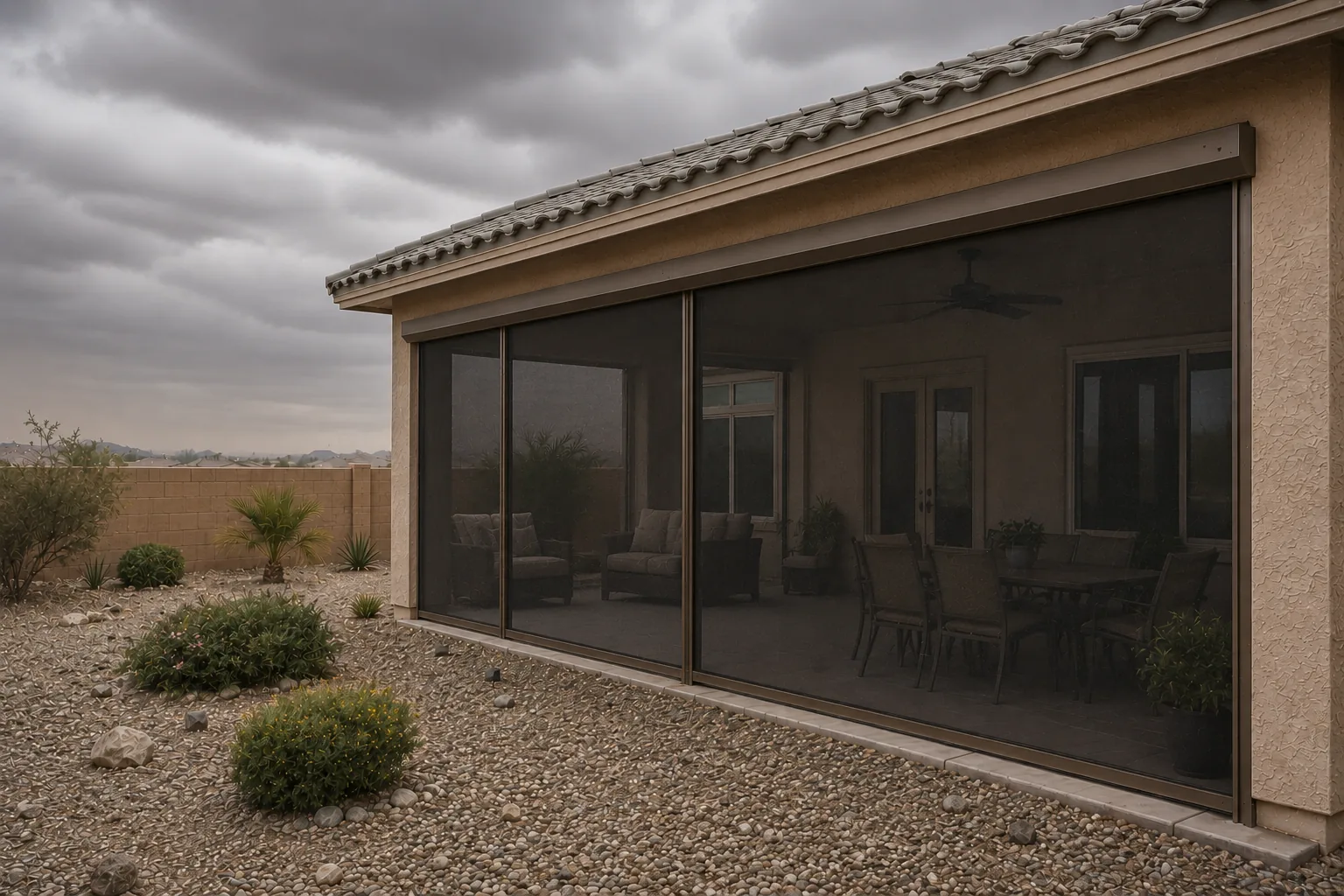
Wind-driven debris
Monsoon storms in the Phoenix area regularly produce sudden wind gusts that turn loose objects into projectiles. Patio furniture, gravel, broken branches, and construction materials from nearby sites can all become airborne in minutes, and glass is what they land on.
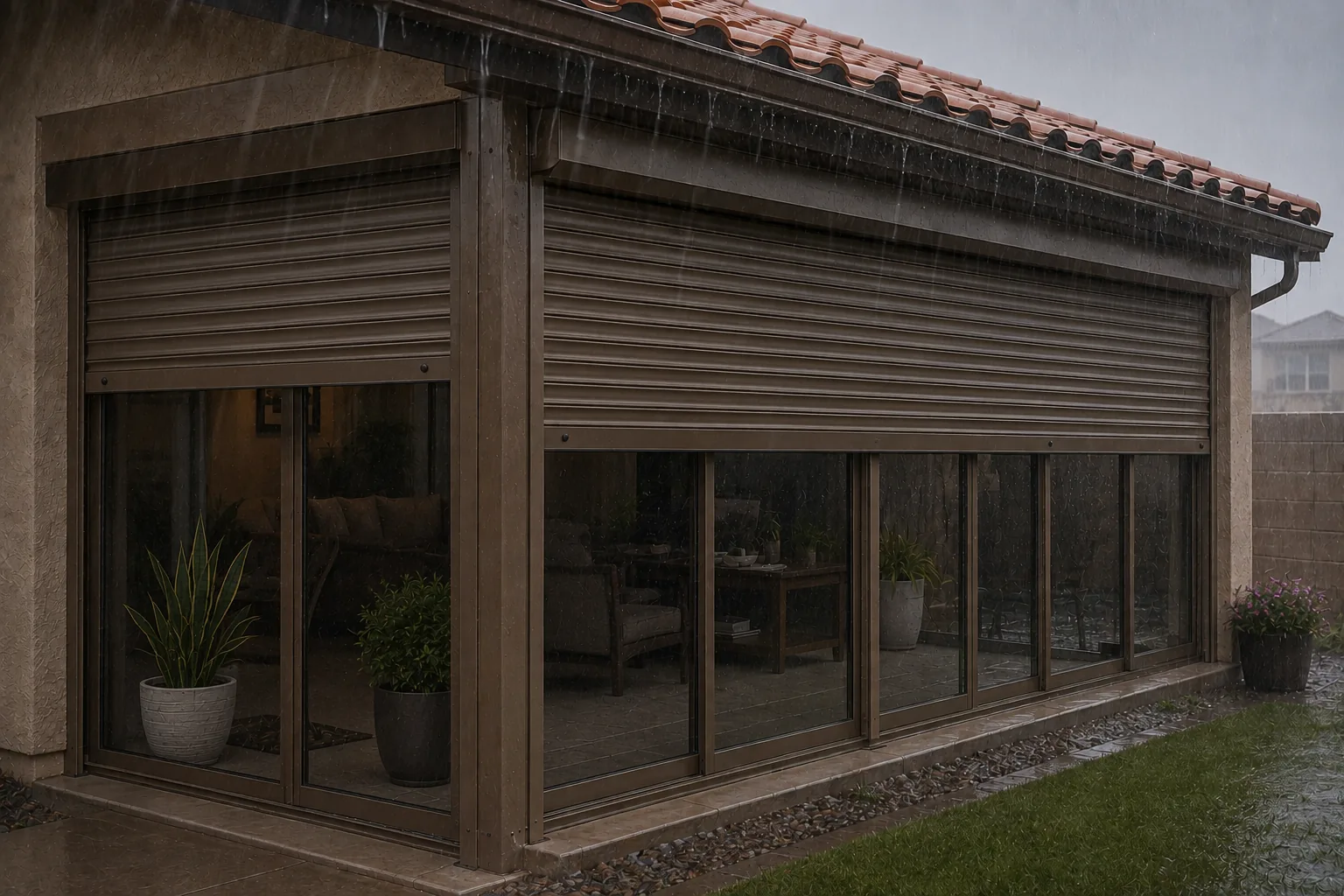
Driving rain
Monsoon rain arrives driven against an opening rather than falling on it. If windows are cracked, older seals have dried out in the summer heat, or sliding doors are not fully latched, water intrusion is a real risk.
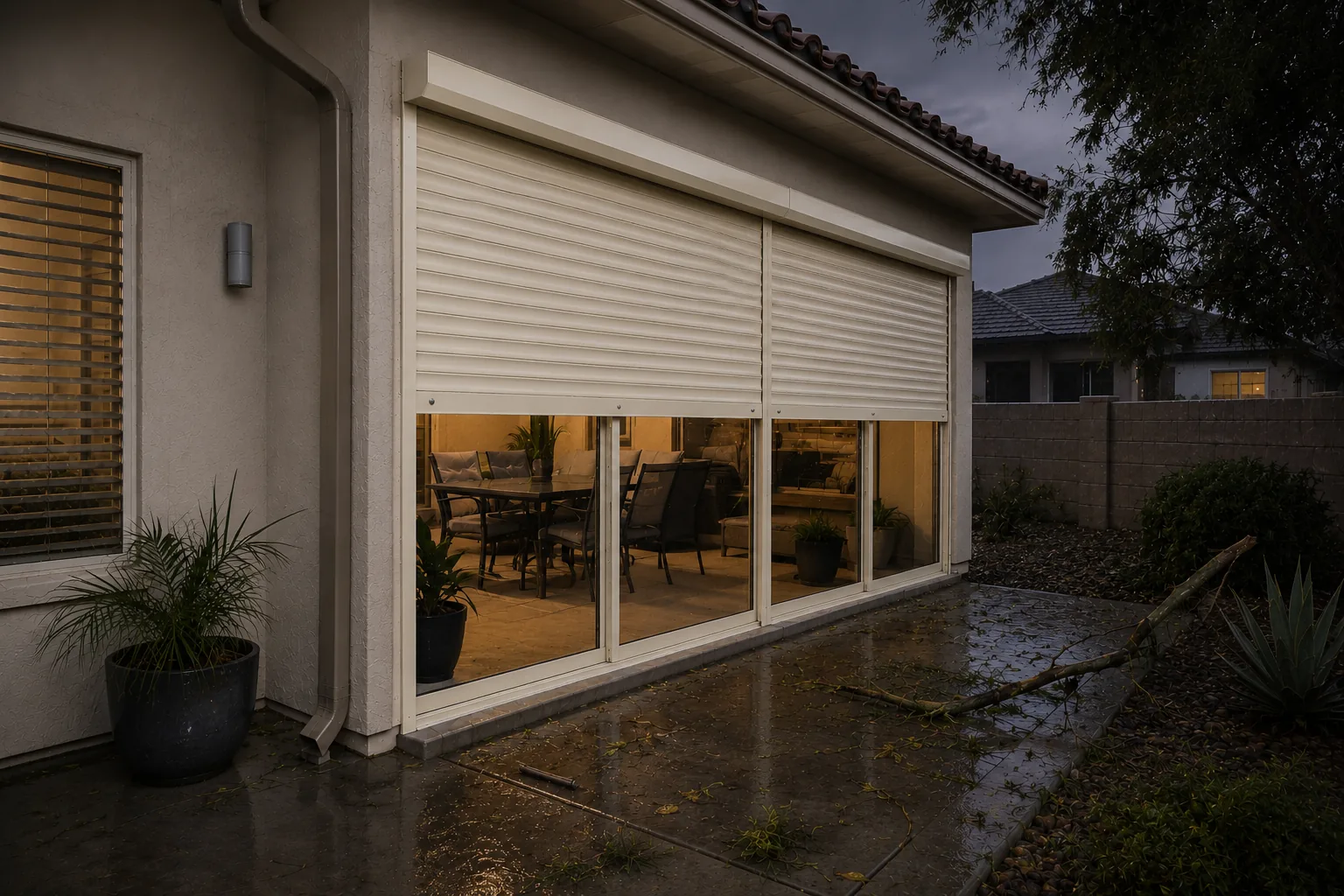
After the storm
Monsoon storms frequently knock out power across the Phoenix metro. That can leave an opening you meant to cover sitting exposed overnight, with no way to close a motorized product until service returns, and a cleanup waiting for you in the morning.
Pick Your Product
Do you need a rolling screen or a rolling shutter to defend your property from monsoon and dust?
The short answer is what is behind the opening. Glass takes a shutter. Open space takes a screen. Both come in residential and commercial builds.
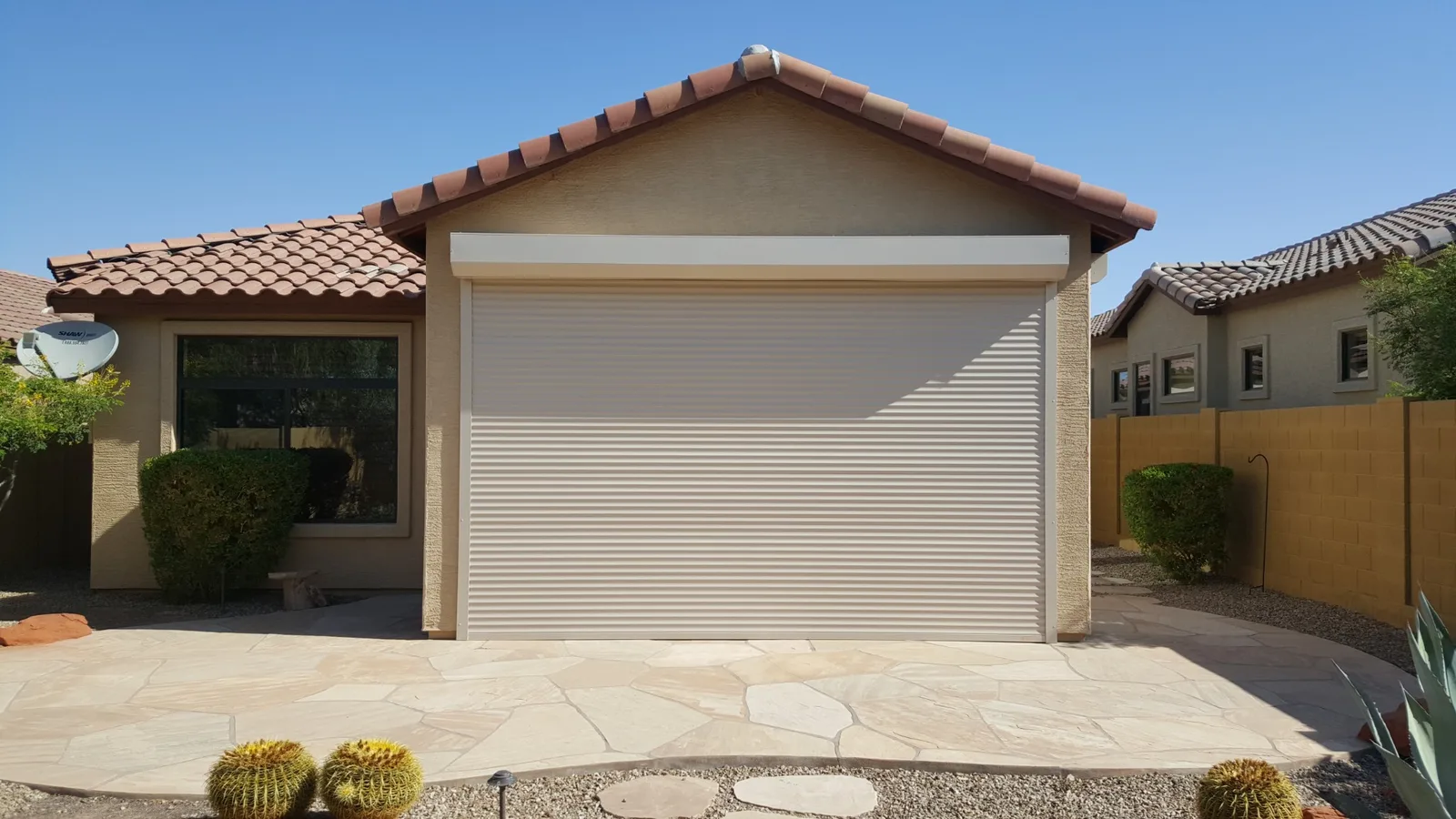
Rolling shutters
Residential and commercial
The product that goes over glass. Windows, patio doors, and entry doors at home. Storefronts, service counters, and bay openings at a business.
- Covers the glass from the outside, so dust, debris, and rain meet aluminum first
- Helps protect windows and doors from wind-blown dust and debris during monsoon storms
- Substantially reduces dust infiltration, though it does not create an airtight seal
- Deflects driving rain before it reaches the window frame
- Blocks the sun before it reaches the glass to cut heat and glare
- Adds a physical security layer that does not depend on electricity, with manual override or battery backup in an outage
- Closed to the view while it is down. The curtain is a continuous solid aluminum barrier
- No wind, impact, or debris rating is published for any Roll-A-Shield product, so we claim none
Choose a shutter for any opening with glass behind it.
Residential rolling shutters → Commercial rolling shutters →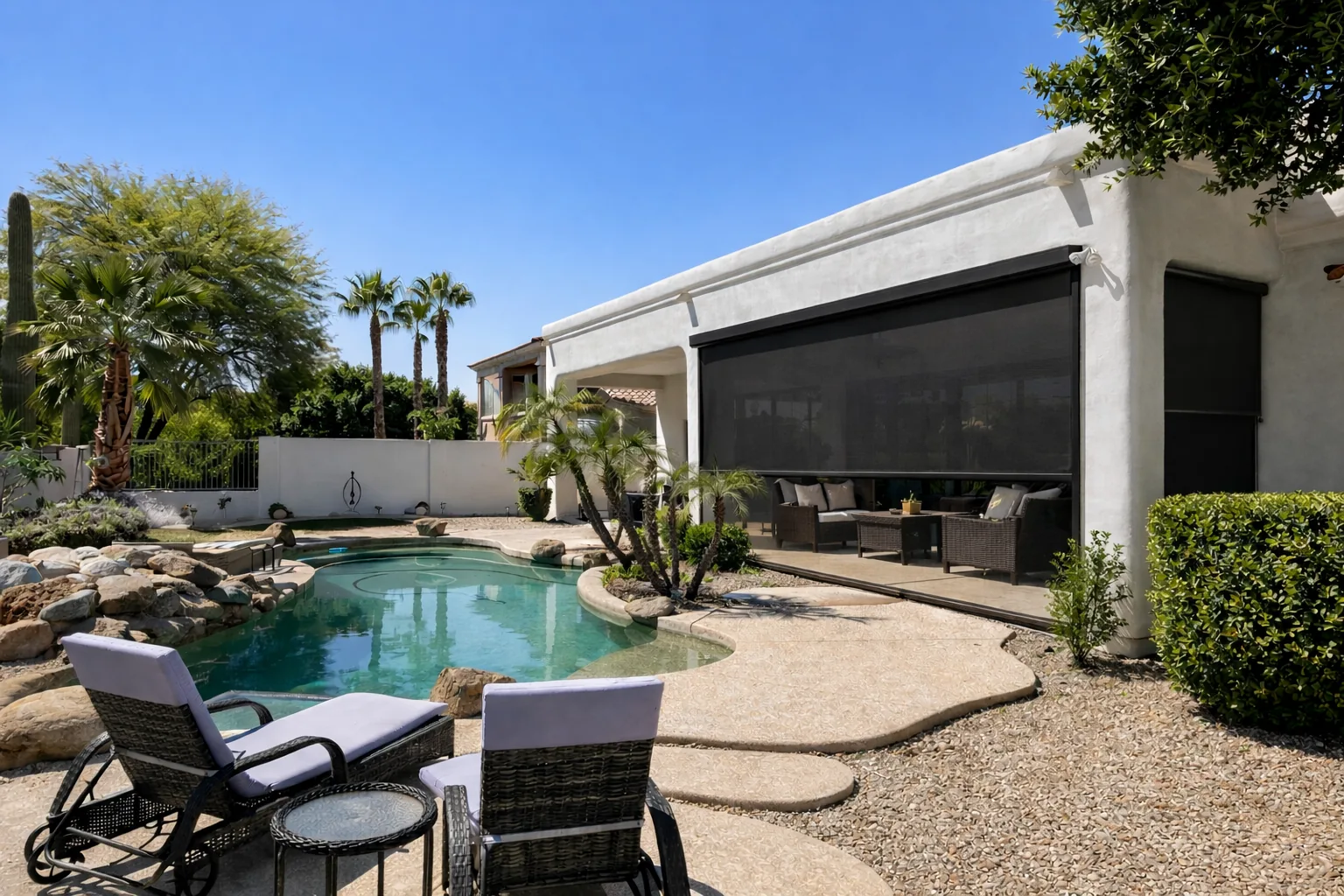
Rolling screens
Residential and commercial
The product that goes over open space. Covered patios, pergolas, and lanais at home. Large openings, garage bays, and commercial storefronts at a business.
- Covers an opening that has no glass behind it to protect
- Blocks up to 95% of heat and harmful UV rays
- Keeps your view clear while closed, and retracts completely when not in use
- Tight-weave mesh keeps mosquitoes, flies, gnats, and other pests out while still allowing airflow
- Seals against side tracks to prevent gaps at the edges of the opening
- Mesh, not a solid storm barrier, and not a security product
- Does not replace a rolling shutter on glass
- Retract it when high winds are expected rather than leaving it closed against them
Choose a screen for a covered patio or outdoor room, and retract it when the wind gets up.
Motorized retractable patio screens → Patio and outdoor living enclosures →Shutters Or Screens
Which one handles which threat
Both products close an opening. They do not do the same job once a storm arrives. Use this to sort your own openings before you call.
| Compare | Rolling shutters | Motorized rolling screens |
|---|---|---|
| What the opening is | Rolling shuttersWindows, doors, patios, and storefronts. Security, shade, privacy, and storm protection for windows, doors, and commercial openings. | Motorized rolling screensCovered patios, pergolas, lanais, large window openings, garage bays, and commercial storefronts. Retractable coverage for patios, outdoor living areas, and large openings. |
| Blowing dust | Rolling shuttersClosed shutters cover the glass and help protect windows and doors from wind-blown dust and debris during monsoon storms. They substantially reduce dust infiltration by covering the opening from the outside before dust reaches your window frame or interior. They do not create an airtight seal. | Motorized rolling screensThe fabric is a woven mesh, supplied in a range of openness grades, so a closed screen cuts what blows into a covered space without sealing it off. Tighter weaves let less through. A screen is not a dust barrier over glass the way a closed shutter is, and no dust reduction figure is published for screens. On a dust day the pairing is a shutter on the glass and a screen on the patio. |
| Wind-driven debris | Rolling shuttersClosed shutters help protect windows and doors from wind-blown debris during monsoon storms. Rolling shutters create a continuous, solid aluminum barrier over windows and doors. No wind, impact, or debris rating is published for any Roll-A-Shield product, so none is claimed. | Motorized rolling screensNot a debris barrier. A screen is mesh. Our published guidance is that motorized patio screens can be retracted quickly when high winds are expected. |
| Driving rain | Rolling shuttersThe closed shutter face acts as a first barrier that deflects driving rain before it ever reaches your window frame. Especially useful on windows with older seals or frames that have experienced Arizona’s heat cycling over many summers. | Motorized rolling screensNot a rain barrier. The fabric is an open mesh, so driven rain passes through it rather than being deflected off it. A closed screen keeps sun and insects out of a covered space. It does not keep water out of one. |
| Sun and heat | Rolling shuttersBlocks the sun before it reaches the glass to cut heat and glare. | Motorized rolling screensBlocks up to 95% of heat and harmful UV rays. All fabrics are US-made, UV-blocking performance mesh rated to block up to 95% of heat and UV rays. |
| Security when closed | Rolling shuttersA locked shutter requires significant forced effort to compromise, giving your home a physical security layer that does not depend on electricity or an active alarm signal. | Motorized rolling screensNot a security product. If your priority is break-in protection, we build rolling security shutters for the same openings. |
| Visibility when closed | Rolling shuttersClosed to the view. The curtain is a continuous solid aluminum barrier over the opening. | Motorized rolling screensKeeps your view clear while closed. Screens retract completely when not in use. |
| Operation | Rolling shuttersTailored to how you want to use it, from a simple manual pull to full smart-home control. Remote control and wall switches, smartphone with Alexa and Google, solar and battery motors, manual operation and override. You can close all your shutters in seconds using a single remote, a wall switch, or a smartphone app. | Motorized rolling screensThree options. Solar-powered remote with premium Italian-made solar motors and no wiring, hardwired remote with a Bond Bridge for smartphone control, or gear-operated manual hand crank. Group multiple screens together and control your entire patio with a single tap. |
| What we recommend before a storm | Rolling shuttersClose them. Arizona monsoon storms move quickly, and closing your shutters in advance is safer and easier than trying to do so once winds pick up. | Motorized rolling screensRetract them. Motorized patio screens can be retracted quickly when high winds are expected. Worth knowing before the season starts: wind damage is excluded from the rolling screen warranty, so retracting ahead of a storm is the manufacturer’s expectation, not just our advice. |
Rolling Shutters
What a closed shutter does during a storm
A rolling shutter is an exterior aluminum shutter that rolls down over a window, door, or opening from a slim box mounted above it, and rolls back up out of sight when you do not need it. Here is what that means once a storm is on the way.
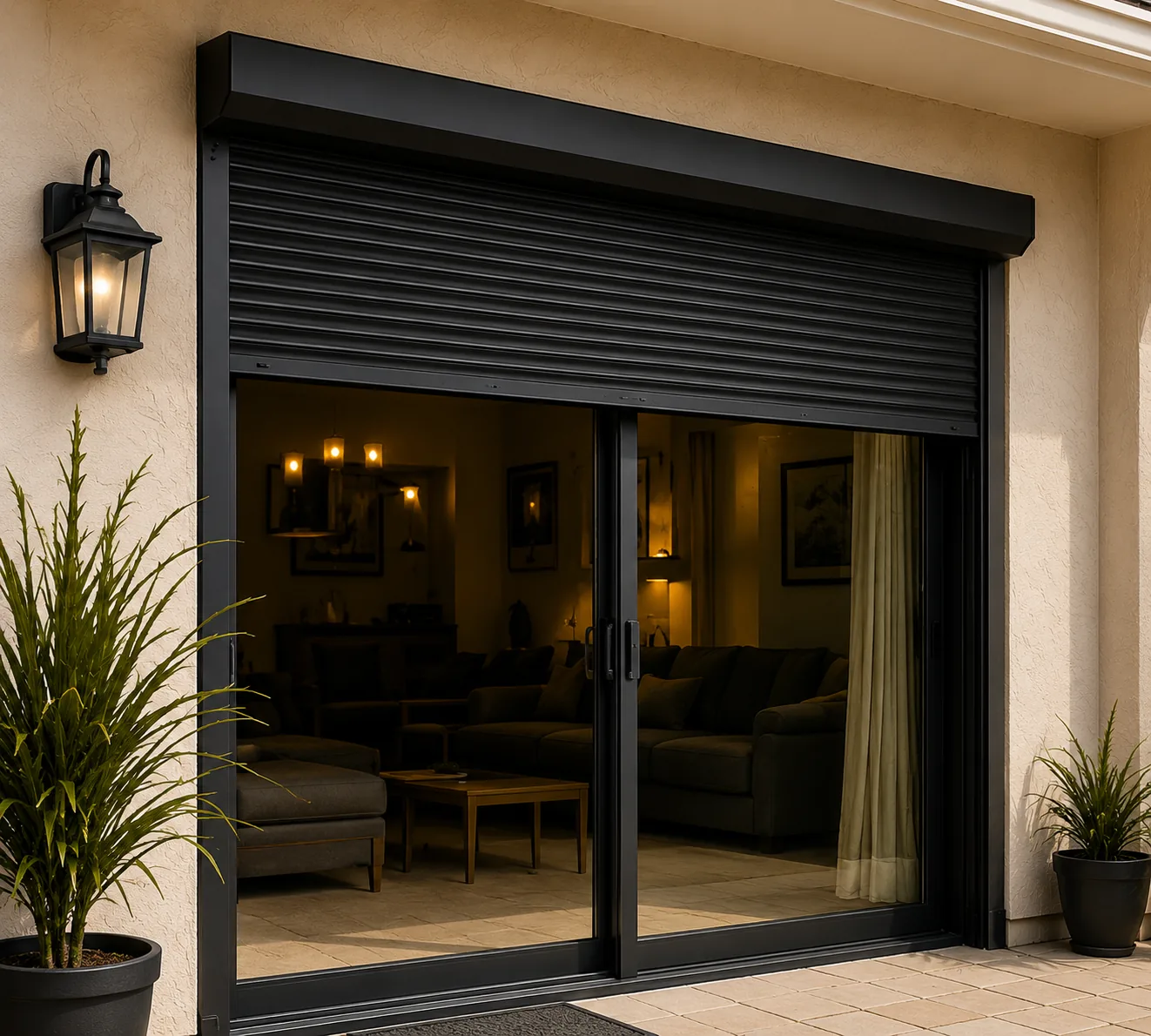
It sits outside the glass
The shutter mounts on the exterior of the opening, so dust, debris, and rain meet aluminum instead of your window. Closed shutters cover the glass and help protect windows and doors from wind-blown dust and debris during monsoon storms. The closed shutter face also acts as a first barrier that deflects driving rain before it ever reaches your window frame.
See window and door shutters →
The curtain covers the whole opening
Rolling shutters create a continuous, solid aluminum barrier over windows and doors. Because the curtain covers the opening from the outside, it substantially reduces dust infiltration before dust reaches your window frame or interior. It does not create an airtight seal, but it significantly limits the amount of fine desert dust that enters your home compared to an uncovered window.
See the 63 mm HD solid slat →
Guide rails hold the curtain in its track
The curtain is captured on both sides by guide rails fastened to the jamb, plumb and square, so it stays in its track rather than swinging free. Our shutters are built with durable aluminum construction, secure side rails, and reliable locking systems specifically suited to the expansion, contraction, and UV exposure that Arizona’s climate demands year-round.
Ask about the optional storm bar. It is a removable, spring-loaded bar that latches across the closed shutter and into the guide rails, adding extra hold when wind is pushing against the curtain. It matters most on exposed openings like a patio or a deck, where there is open air behind the shutter instead of a wall. On a window set into the house it is usually not needed. Your specialist will tell you which of your openings call for one during the free on-site estimate.
See the 38 mm insulated slat →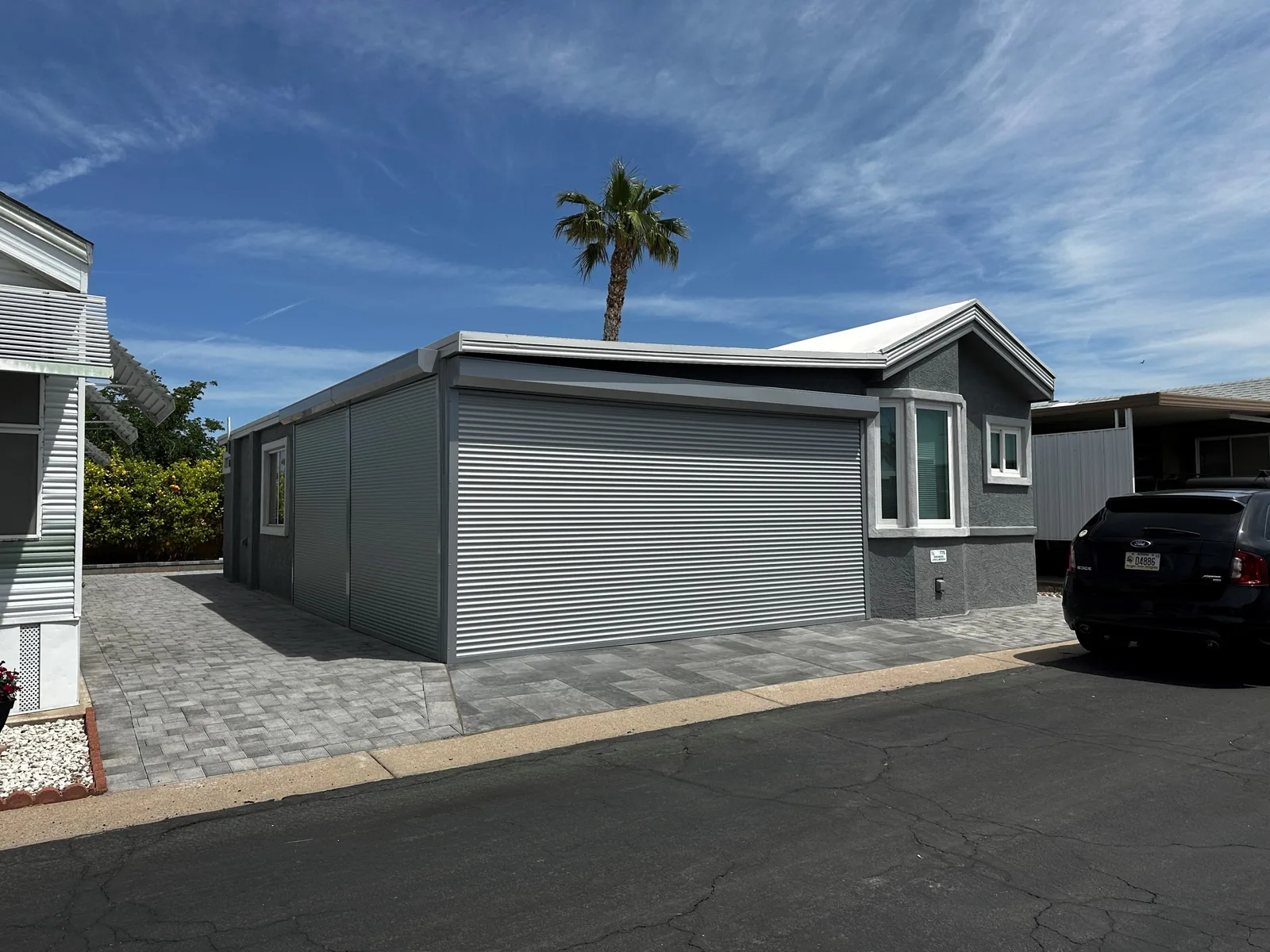
The same shutter works the other 300 days
The shutter you close against dust is the same one that blocks the sun before it reaches the glass to cut heat and glare, and the same one that covers an opening while you are away. A locked shutter requires significant forced effort to compromise, giving your home a physical security layer that does not depend on electricity or an active alarm signal.
See the 55 mm insulated slat →Four slat profiles: we build the 38 mm insulated slat, the 55 mm insulated slat, the 63 mm HD solid, and the 63 mm HD perforated, so the shutter is matched to the opening rather than trimmed down from a stock size.
See all rolling shuttersRolling Screens
What a closed screen does, and what it does not do
Screens cover a different kind of opening, and they play a different role once the wind picks up. This part is short on purpose.

It covers an opening that has no glass
Motorized rolling screens are built for covered patios, pergolas, lanais, large window openings, garage bays, and commercial storefronts. On a patio there is no window to protect, so the screen is covering the space itself rather than a pane.
See patio and outdoor living enclosures →What a screen is not: a screen is a mesh product, not a solid storm barrier, and it does not replace a rolling shutter on glass. If your priority is break-in protection or storm impact rather than shade and bugs, we build rolling security shutters for the same openings. Our guidance during monsoon season is direct: motorized patio screens should be retracted quickly when high winds are expected, not left closed against them.
See motorized retractable patio screensWhich One For Which Opening
Match the product to the opening
Most Metro Phoenix homes end up with a combination rather than one product everywhere. Here is how the five most common openings usually go.
Openings vary more than lists do. A local specialist evaluates the opening and recommends the best solution during your free on-site estimate, and confirms the combination that fits your home.
Request a Free QuoteWhere This Matters
The openings that take the storm first
The same protection applies across the property. Residential first, because that is where most monsoon calls come from.
Residential
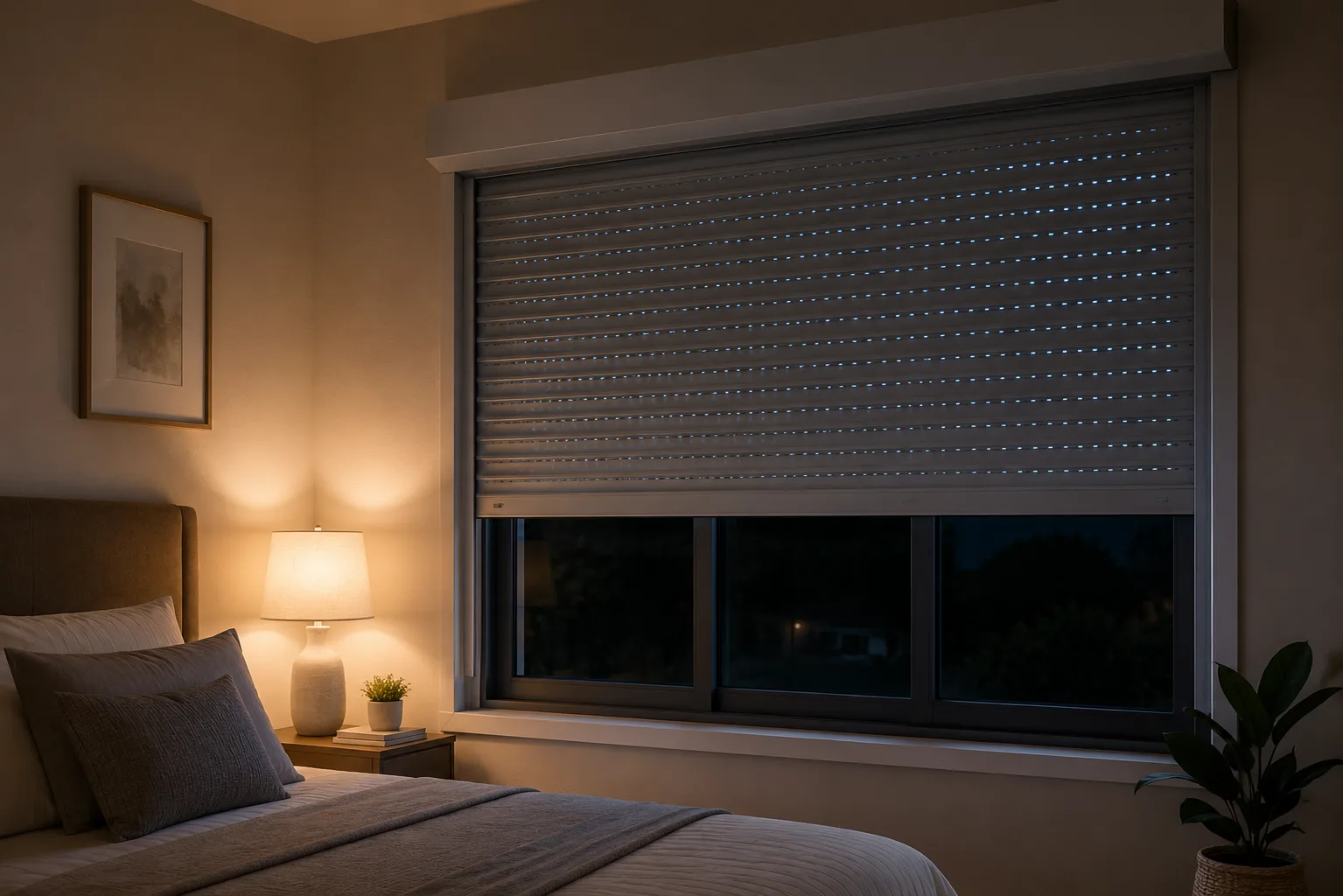 Cover the glass on every exposure. Start with west and south-facing glass. That is where the storm front arrives first.
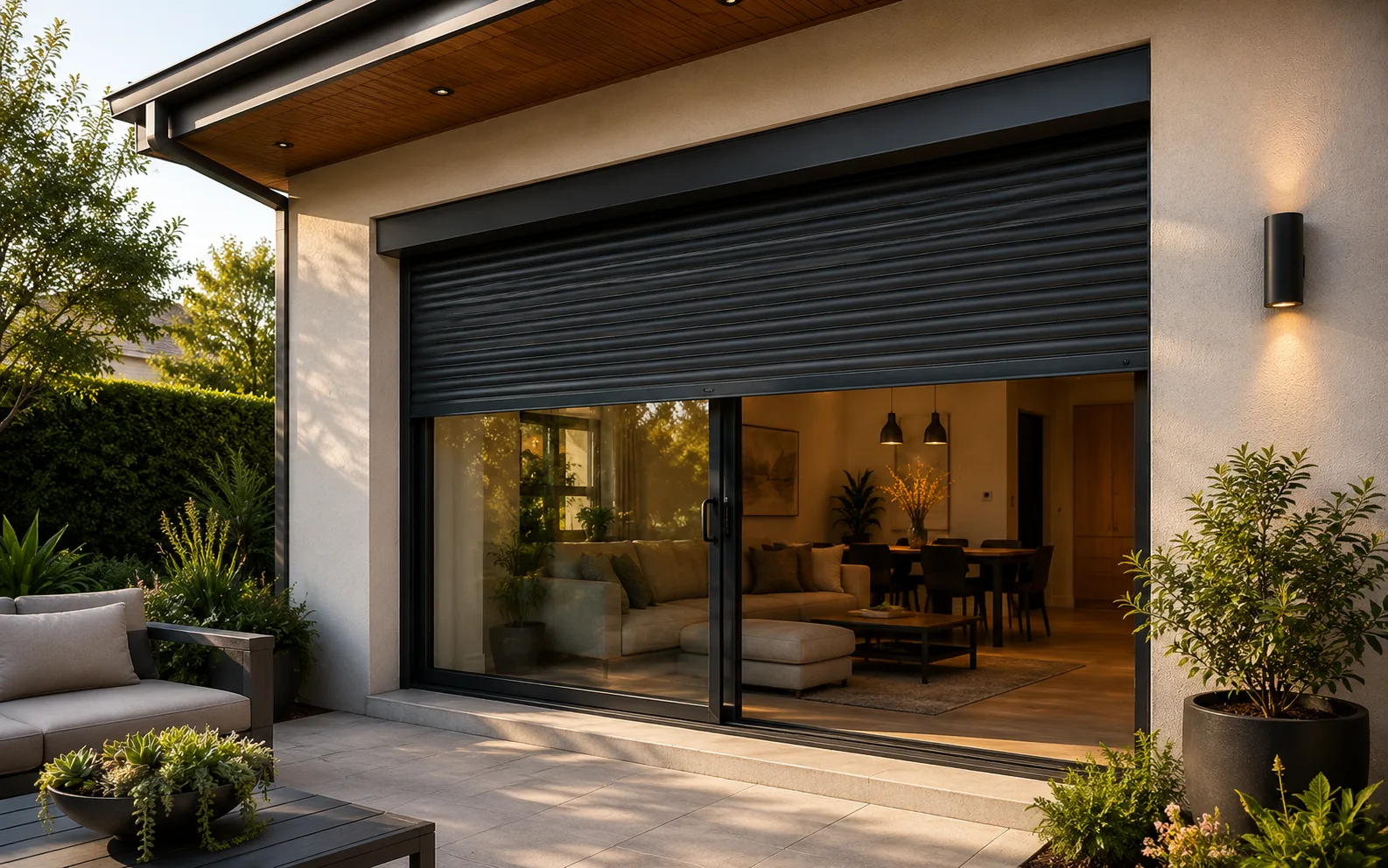 The largest openings in most Valley homes. The most costly opening to repair and the hardest to close by hand once wind picks up.
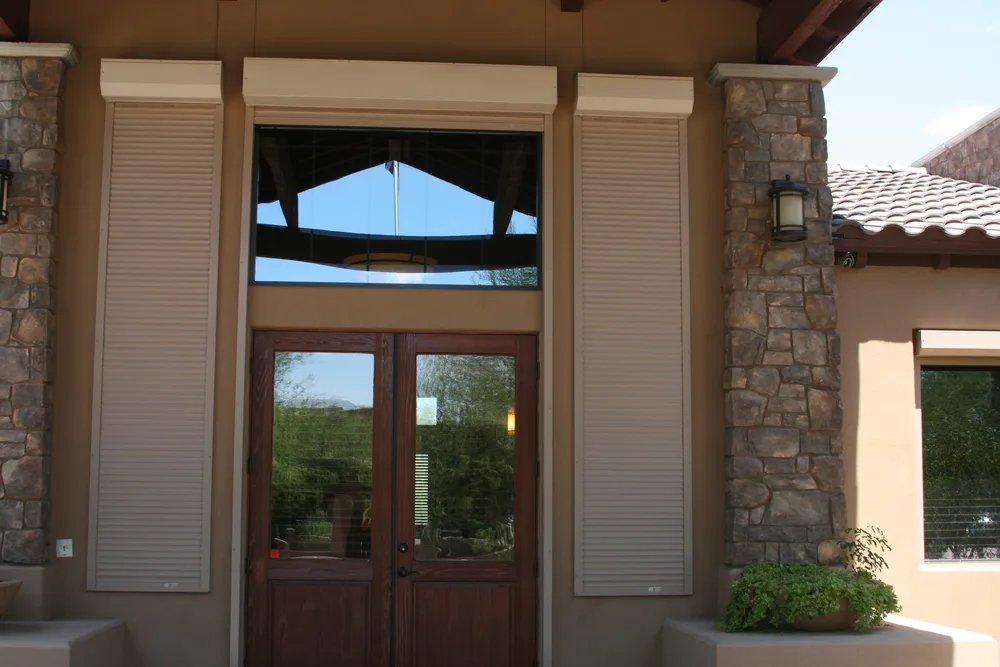 Front, side, and service entries. Door seals are a direct dust path into the house during a haboob.
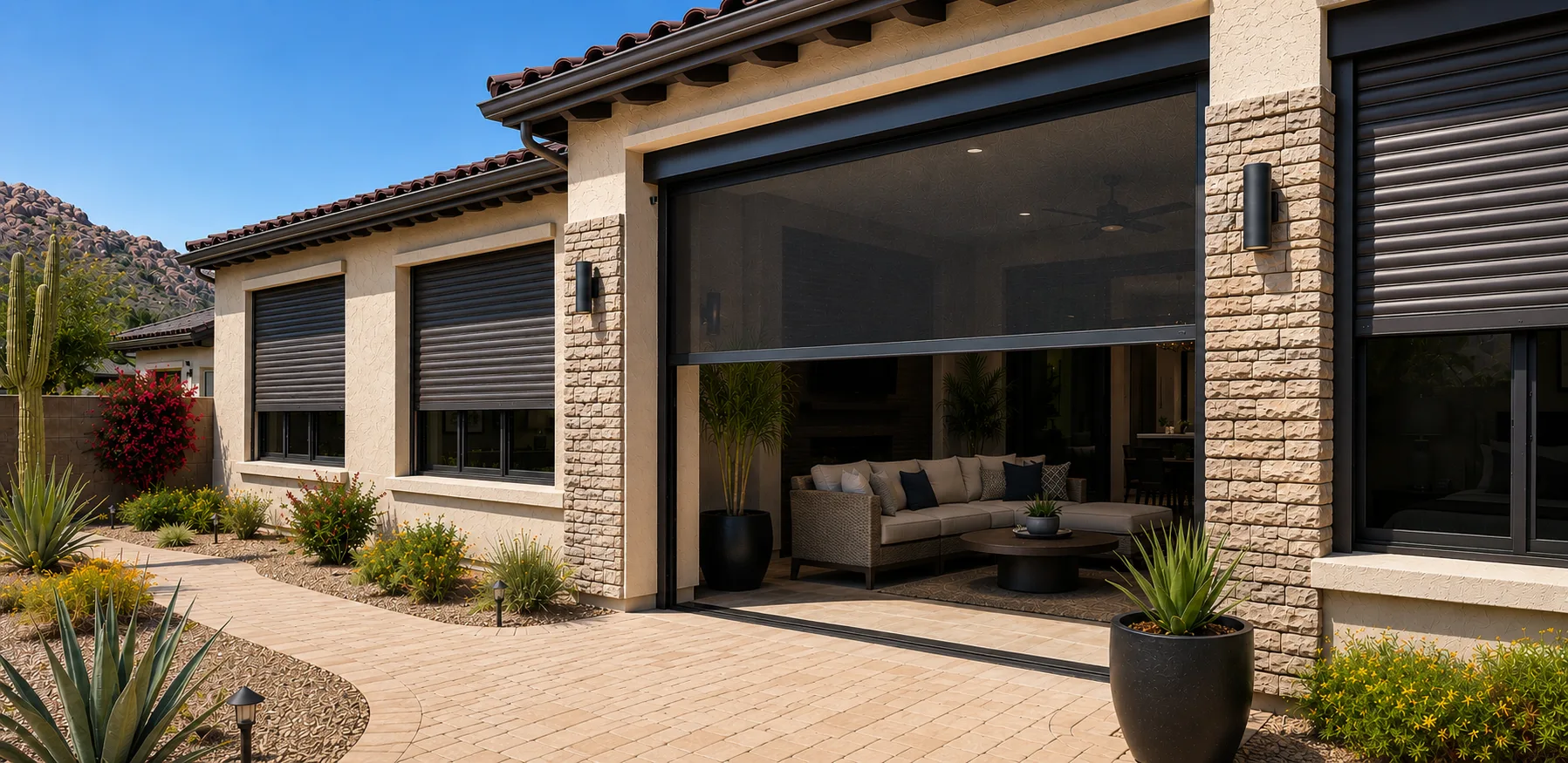 Covered patios and outdoor rooms. Screens close the space day to day and retract when high winds are expected.
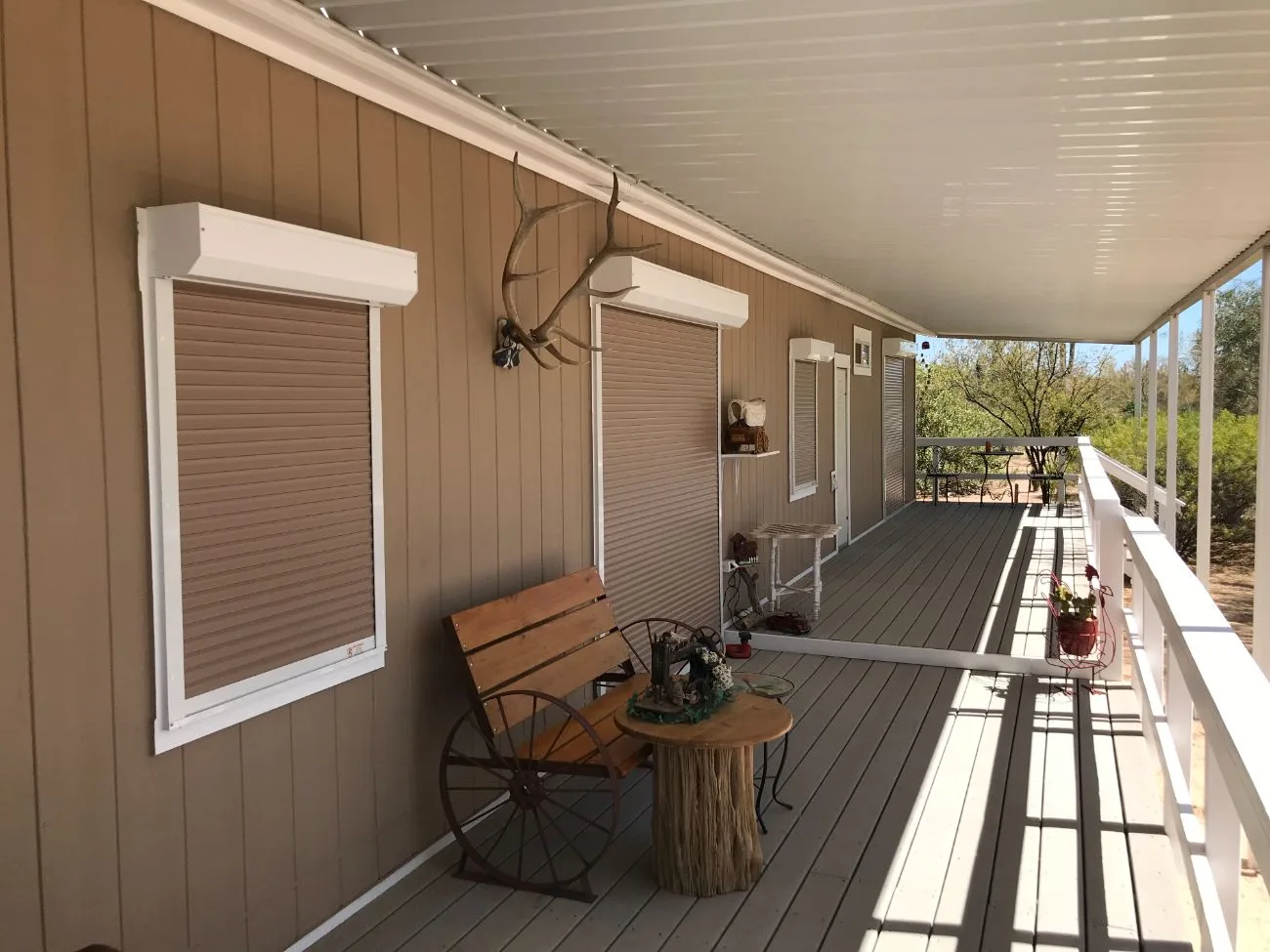 Block the sun before it reaches the glass to cut heat and glare.
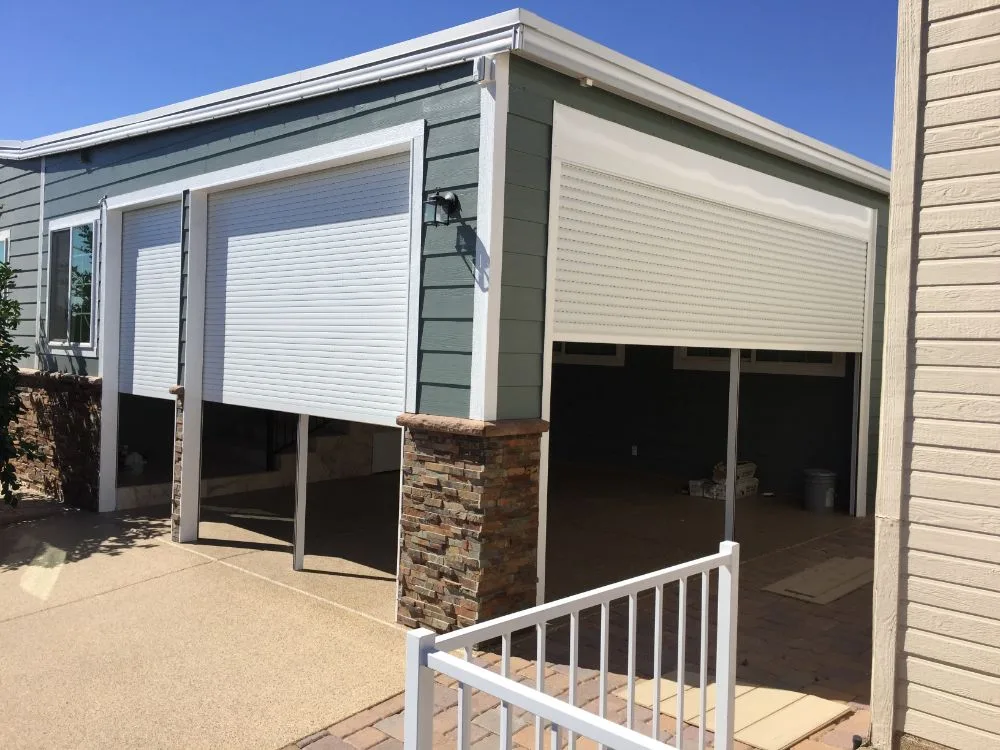 Secure a property you are not living in year-round. Monsoon season runs through the months most seasonal owners are away.
Commercial
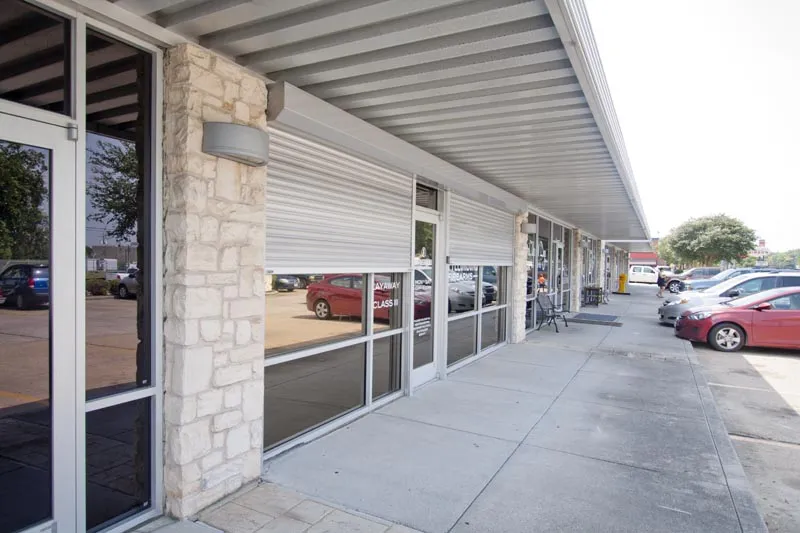 Secure the opening after hours. Large glass frontage exposed to blowing dust and debris.
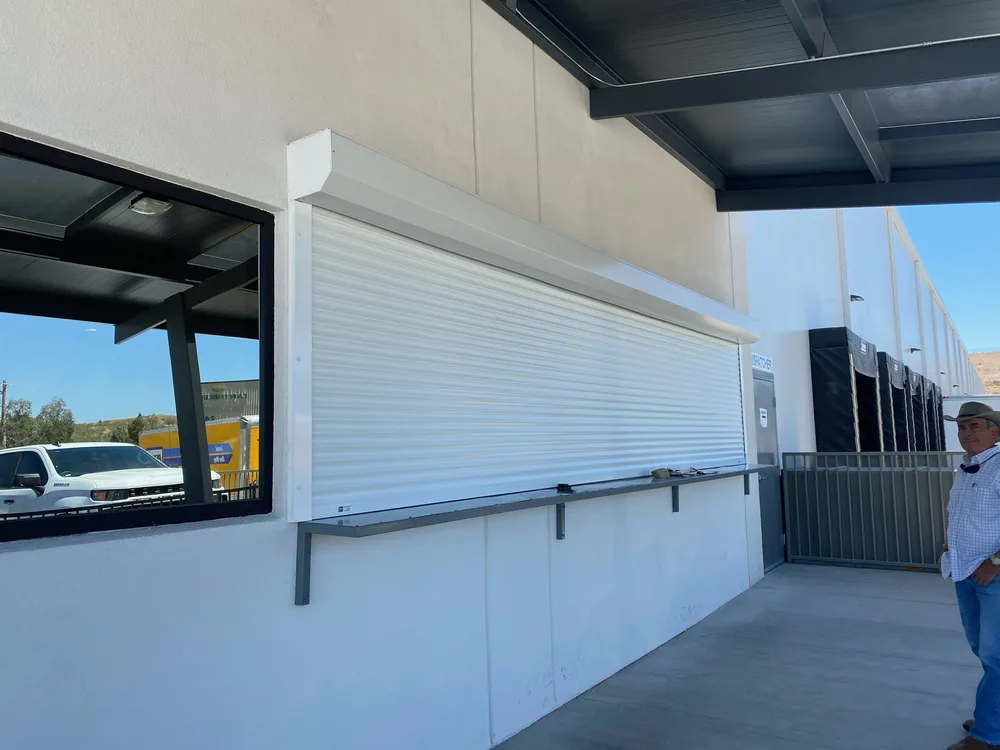 Close the counter, keep the space open.
 Control access to open-air service areas. Outdoor service areas take dust directly.
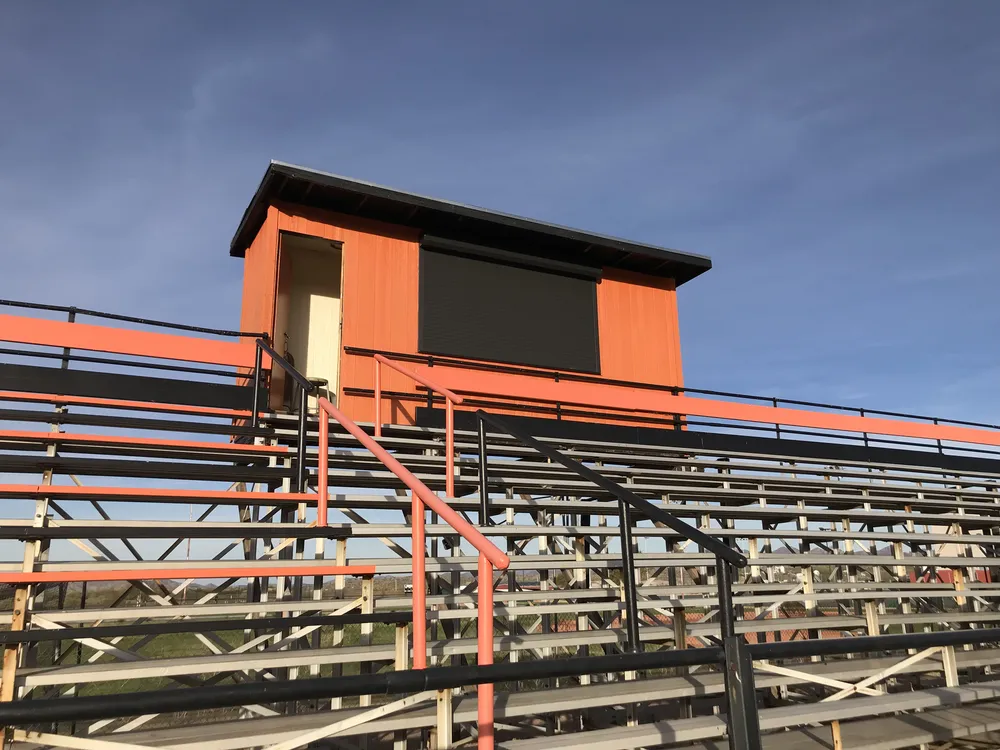 Protect glass across a large facility.
 Full concealment when closed.
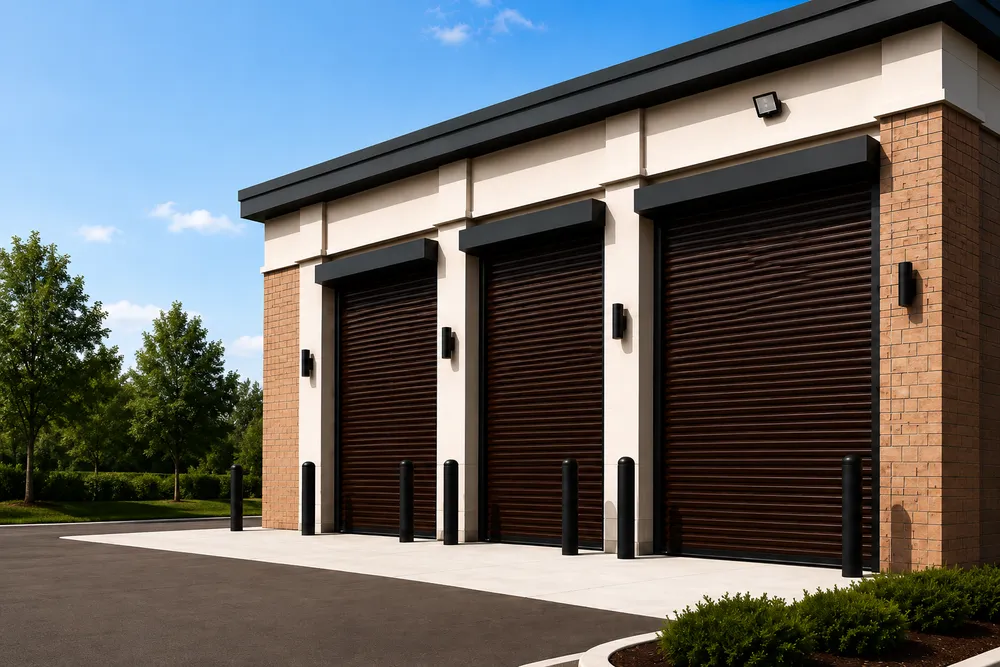 Cover openings across the building. Dock and bay openings are the dust entry point on most industrial sites.
How You Run Them
Remote, solar, or switch
Both systems can be motorized. Here is how you run an opening day to day and keep it working when the power drops.
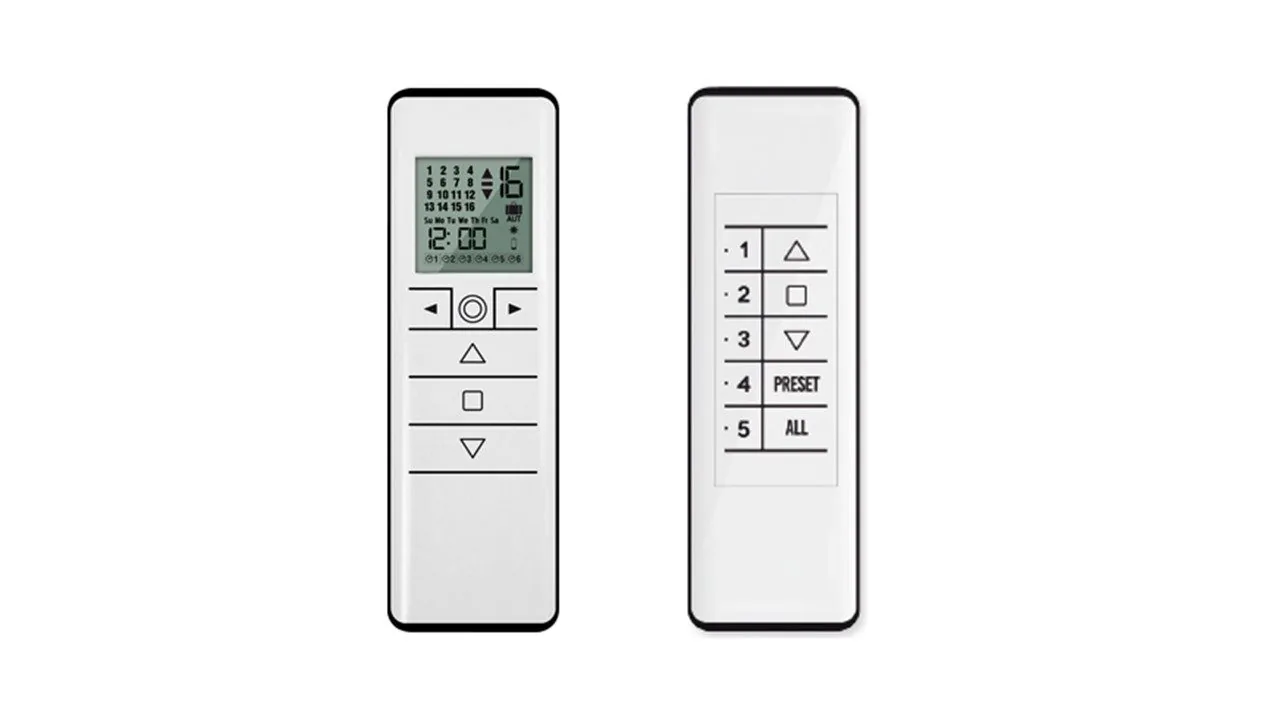
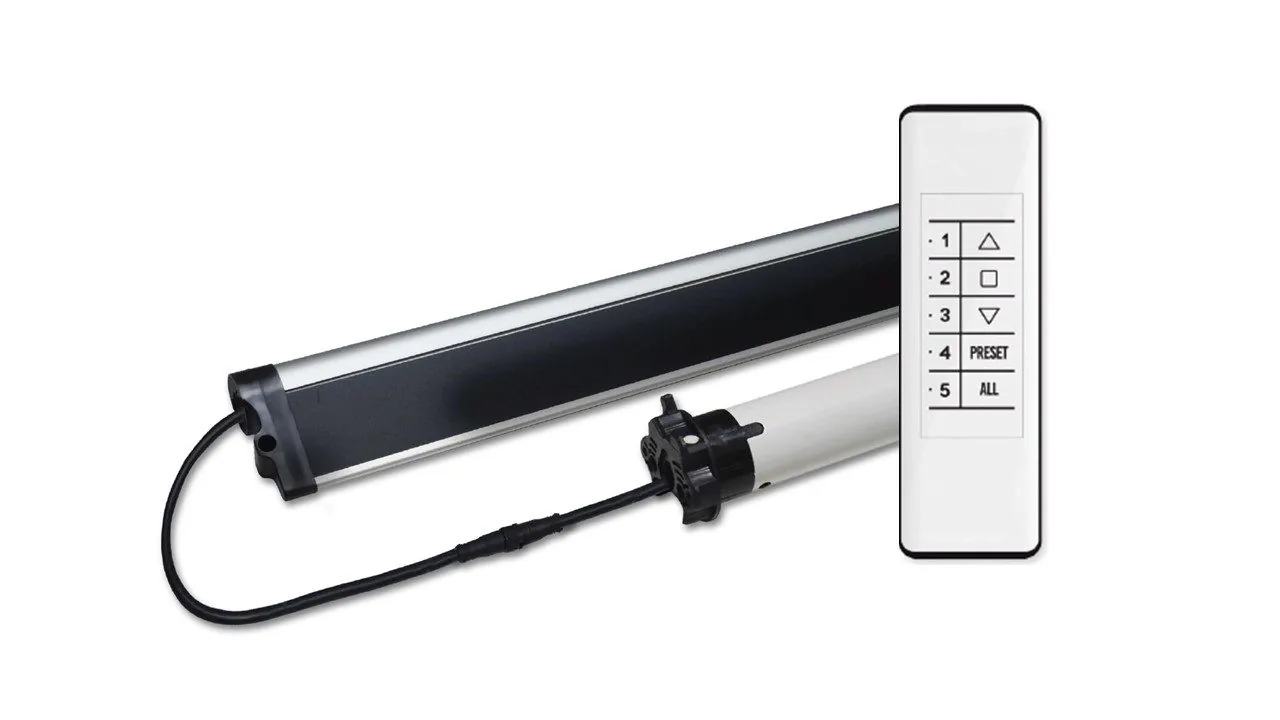
Run a single opening from a handheld remote, or wire it to a wall switch that stays put.
Motorized patio screens can use solar-powered motors, so no new wiring runs to the patio.
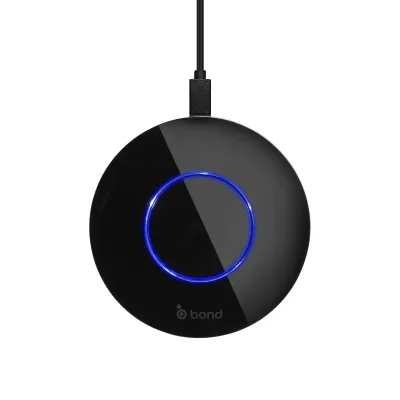
Integrate with common smart-home systems to run openings on a schedule or by voice.
Financing available
Ask about current financing options during your free estimate and spread the cost of your rolling shutter project over time.
Inside The Build
The parts that do the work in a storm
A shutter or a screen is an assembly, and each part has a job once the wind picks up. Here is what is actually holding the line.

Slat and curtain
The curtain is made of interlocking aluminum slats that form a continuous, solid barrier over the window or door. We build four profiles, the 38 mm insulated slat, the 55 mm insulated slat, the 63 mm HD solid, and the 63 mm HD perforated, so the shutter is matched to the opening rather than trimmed down from a stock size. Aluminum construction and finishes are chosen to handle intense sun, heat, and dust year round.
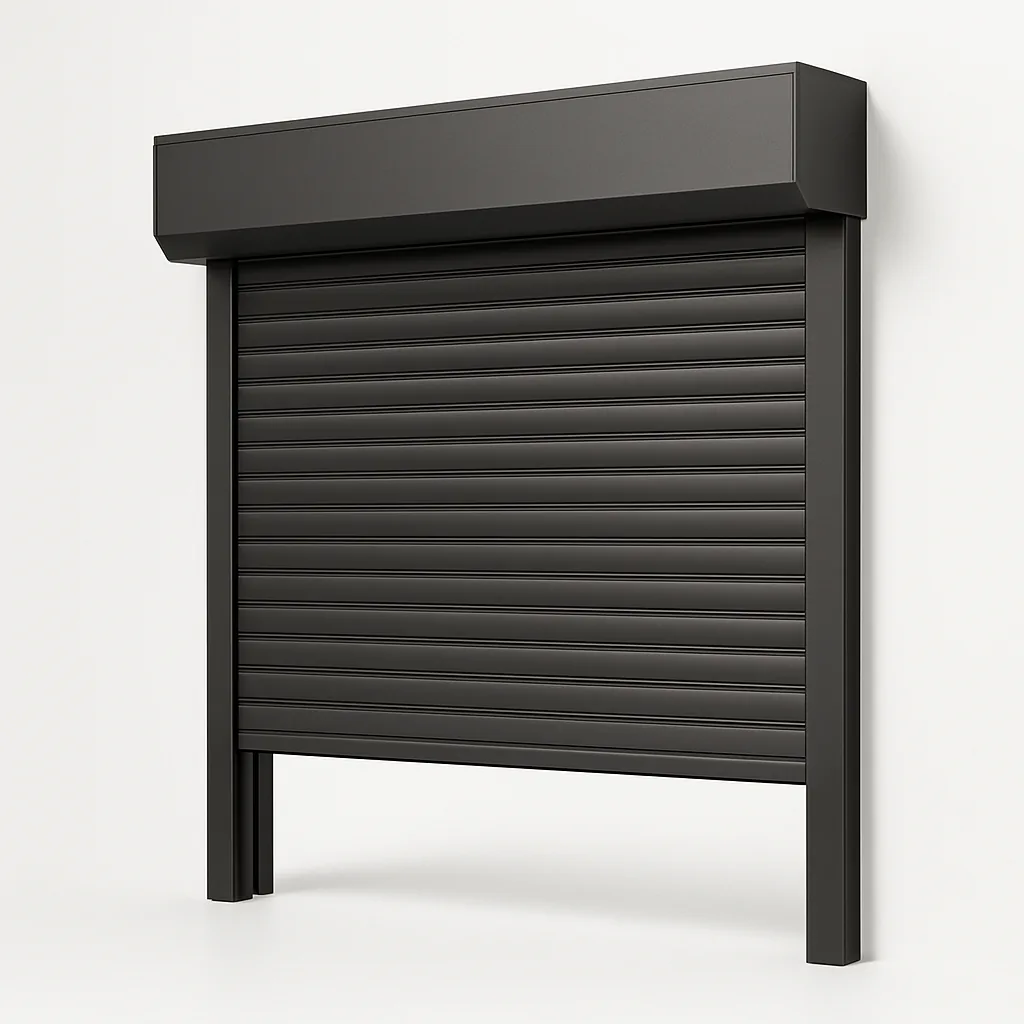
Guide rails and box
The curtain is held on both sides by guide rails fastened to the jamb, plumb and square. Above the opening, a slim box houses the curtain when the shutter is open and the curtain rolls back up out of sight. The whole assembly mounts on the exterior of the opening, which is why dust, debris, and rain meet the shutter rather than the glass.

Motorization and controls
Every rolling shutter can be tailored to how you want to use it, from a simple manual pull to full smart-home control: remote control and wall switches, smartphone with Alexa and Google, and solar and battery motors. With a motorized system you can close all your shutters in seconds using a single remote, a wall switch, or a smartphone app, which matters when a storm is already visible. Rolling shutters with manual override or battery backup allow you to secure your windows even when the power is out, and we offer optional battery backup solutions that allow motorized operation even during extended outages.
See motors and controls →
Screen mesh and side tracks
Screens only. The fabric is US-made, UV-blocking performance mesh, tight-woven enough to keep mosquitoes, flies, gnats, and other pests out while still allowing airflow. The screen seals against side tracks to prevent gaps at the edges of the opening. Screens retract completely when not in use, which is also what we recommend when high winds are expected.
See motorized retractable patio screens →How It Works
Simple process. Custom results.
Request a Quote
Tell us about your property and schedule your free on-site estimate.
On-Site Consultation
A local specialist evaluates the opening and recommends the best solution.
Custom Built
Your shutters are manufactured in Phoenix for the exact opening.
Professional Installation
Our own local crew installs and tests the finished system.
What Affects Price
What monsoon protection costs in Metro Phoenix
Because every shutter is custom-built, there is no one-size price. These are the factors that move the number, reordered for the way monsoon projects usually get scoped.
General guide: a single residential window typically runs about $800 to $3,500 installed. Your exact price comes from a free on-site estimate. See our full cost breakdown for more detail.
Custom rolling shutters typically have a three to four week lead time, so book ahead of June if you want coverage in place for the season.
Read the Cost Guide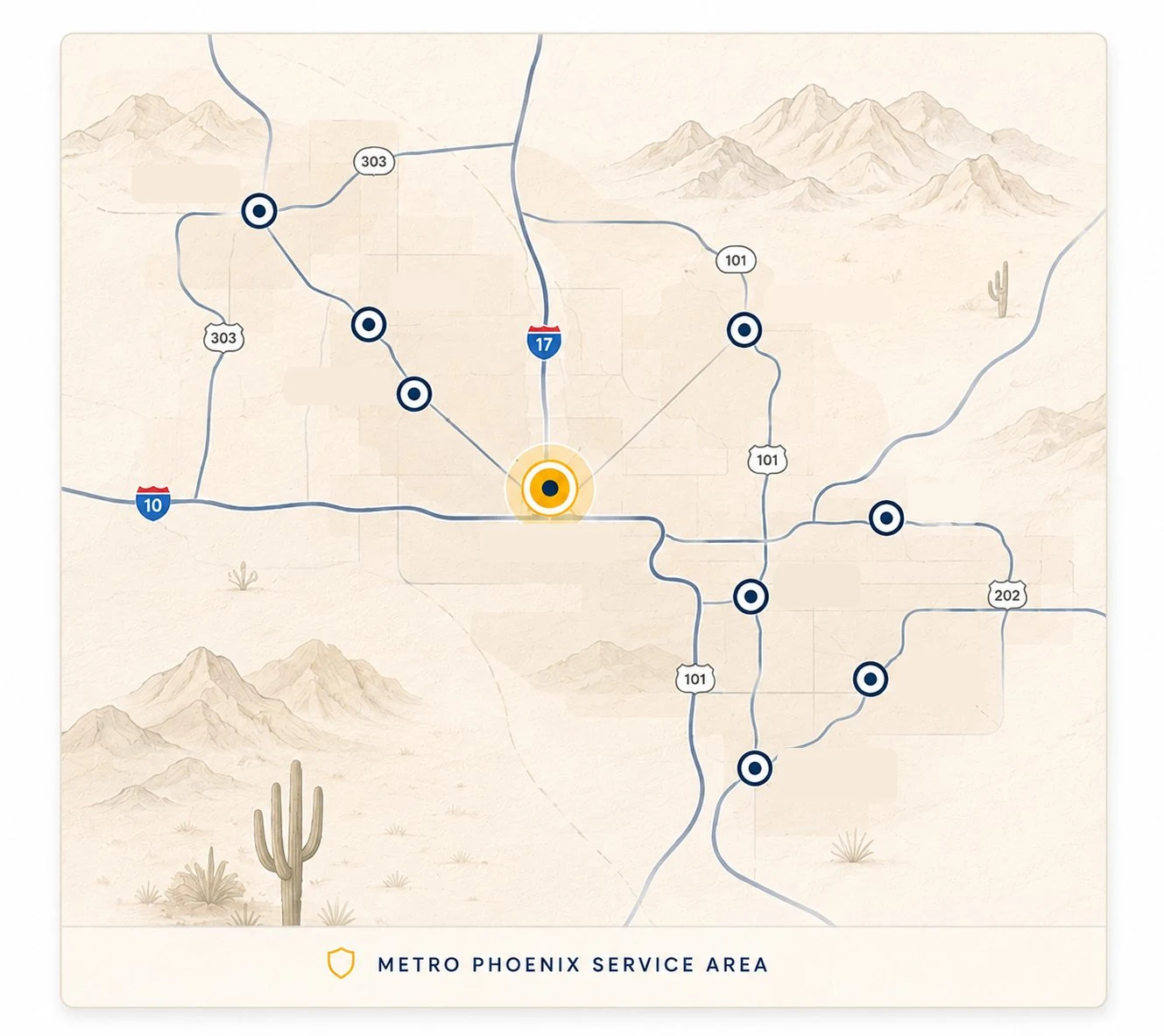
Proudly Serving
Monsoon and dust protection in Metro Phoenix
From Surprise to Gilbert and everywhere in between, we build and install rolling shutters across the entire Valley.
What Our Customers Say
Trusted across Metro Phoenix, monsoon season included
“Absolutely first class business in every respect. Highly recommend the team there. Never had a disappointment in 15+ years as a customer.”
David G.“Roll-A-Shield did a great job, from start to finish. A sales rep gave me a quote for two shades. I ended up only going with one, but was not pressured, at all, to also get the other shade. Pricing was fair, and they delivered exactly what I asked for in the exact date they said they would complete the job. Pleasure to work with everyone I came in contact with.”
Ralph C.“We updated our roller shields. We had the first set over 35 years and have updated the windows and wanted the new roller shields also. Very happy with the new look. We feel much safer in our home with them and it really helps with the electric bills.”
Richard C.★★★★★ 4.9 average across 211 Google reviews. Read them on Google →

Monsoon season runs on a schedule. Get ahead of it.
The season opens June 15. Custom rolling shutters typically have a three to four week lead time, so spring is when the calendar still has room. Schedule a FREE on-site estimate with a local specialist from Roll-A-Shield.
Keep Exploring
Where to go next
This page sorts the openings. These go deeper on the products, the price, the timing, and the coverage.
Metro Phoenix rolling shutters
The full pillar. Slat profiles, colors, operation, applications, and pricing in one place.
See the shutter pillar →Motorized rolling screens
Fabric and frame colors, the three motor options, and what a screen is built to do.
See motorized retractable patio screens →How much do rolling shutters cost?
Real cost ranges and the factors behind them, explained in full.
See the cost guide →Monsoon season prep and install timing
When to book, why spring beats July, and how the season plays out month to month.
Read the timing guide →Metro Phoenix rolling screens
Mesh types, frame colors, and where screens go to work across the Valley.
See rolling screens →Rolling screens cost
Installed price ranges for rolling screens and the factors that move them.
See the screen cost guide →4-week install guarantee
Motorized patio screens installed within 4 weeks of your deposit, or $500 back.
Read the guarantee →Shutter and screen warranty
Full written terms for each product, and how to start a claim.
Read the warranty →Common Questions
Your monsoon questions, answered.
What Metro Phoenix homeowners and businesses ask us most about dust, wind, and rain at the opening.
01What is a haboob, and how is it different from an ordinary Phoenix dust storm?
A haboob dust storm is the wall-like front of dust that forms ahead of a monsoon thunderstorm, and it is a defining feature of Arizona summers. The difference is the shape and the speed. An ordinary Phoenix dust storm is airborne grit on a windy afternoon. A haboob arrives as a visible front, pushes dust ahead of the rain, and is over an opening before most people have finished closing the house. That is why our advice is always to cover openings early rather than react to the wall you can see from the driveway.
02When does monsoon season start in Arizona, and when does it end?
Arizona monsoon season officially begins June 15 and runs through September 30, as defined by the National Weather Service. Those dates do not move year to year, which is what makes Phoenix monsoon season worth planning around rather than reacting to. July and August are typically the most intense months for storm activity in the Phoenix area, so anything you want in place for the worst of it should be ordered in spring.
03How do you keep dust out of a house during a Phoenix haboob?
Work the openings, not the rooms. Close anything that covers glass before the front arrives, starting with west and south-facing windows and doors, since storm fronts frequently move in from the west and southwest. Latch sliders fully, because a door that is closed but not latched is still a gap. Bring in cushions, umbrellas, and plant pots so loose objects near glass do not become the thing that hits it. Then leave the house sealed until the dust has passed rather than airing it out mid-storm.
04Do rolling shutters for windows actually stop haboob dust?
They substantially reduce it. A closed shutter covers the opening from the outside, so dust meets aluminum before it reaches your window frame or your interior. Be clear on what that means: a rolling shutter does not create an airtight seal. What it does is significantly limit the amount of fine desert dust that gets into your home compared with an uncovered window. On the debris side, the closed curtain is a continuous solid aluminum barrier in front of the glass, though we publish no wind, impact, or debris rating for any product and so we claim none.
05Are rolling security shutters the same thing as security screens?
No, and the difference matters when you are searching. Rolling security shutters are exterior aluminum shutters that roll down over the opening, which is what we manufacture in Arizona. Security screens usually means a fixed steel mesh product; we do build a small line of steel security screen doors for front entries, where you want airflow and a barrier at the same time. Retractable patio screens are a third thing again: mesh on a motor, built for shade and insects rather than security. If you want home security shutters, the rolling aluminum product is the one.
06What are residential rolling shutters, and which openings do they suit?
Residential rolling shutters are exterior aluminum shutters that roll down from a slim box above the opening and roll back up out of sight when you do not need them. At home they go on bedroom and living room windows, patio doors, entry doors, and garage or side openings. We build four slat profiles so the shutter is matched to the opening rather than trimmed down from a stock size, and the same product line covers commercial storefronts, service counters, and bay openings for businesses across the Valley.
07Do rolling shutters work on patio doors and large sliders?
Yes, and rolling shutters for patio doors are one of the most common monsoon jobs we quote. A slider is usually the largest run of glass in the house and the hardest opening to cover by hand once wind is up, which is why wide openings are almost always motorized. Width drives the build: bigger openings use more material and heavier operators, and the slat profile is chosen to suit the span. Your specialist measures the opening and confirms which profile and operator it needs.
08What are retractable patio screens, and what do they actually do?
Motorized retractable screens are mesh panels on a motor that roll down across a covered patio, pergola, lanai, garage bay, or large opening and retract completely when you want the space open. Outdoor patio screens do a different job from a shutter: there is no glass behind them to protect, so they are covering the space itself. They cut sun and glare, keep insects out, and turn a covered patio into a usable room. Roll-A-Shield supplies and installs these across the Phoenix metro.
09Do patio screens block UV rays?
Yes, substantially. The mesh is a US-made UV-blocking performance fabric, and the fabric maker rates it to block up to 95% of heat and UV rays. That figure is the fabric manufacturer’s rating rather than a number we measure ourselves, so treat it as the spec of the material. In practice it means a covered patio stays usable through an afternoon that would otherwise drive you indoors, and the furniture underneath fades more slowly.
10Can roll down patio screens give me privacy?
Partly, and it depends on the fabric you choose. The mesh comes in a range of openness grades and colours, and the tighter the weave the less anyone sees through it. Darker fabrics also read as more private from outside during the day while keeping your own view out reasonably clear. Patio screens for privacy work best where you are screening a sightline from a neighbour or a street rather than trying to black out a room. If full privacy on demand is the goal, a rolling shutter does that job properly.
11Should I leave retractable screens for the patio closed during a dust storm?
No. Retract them. A screen is a mesh product, not a solid storm barrier, and our guidance during monsoon season is that motorized patio screens should be retracted quickly when high winds are expected rather than left closed against them. There is a practical reason as well as a physical one: wind damage is excluded from the rolling screen warranty, with no wind speed threshold under which a claim would be honoured. On a still, dusty afternoon a closed screen is fine. When the wind is the story, roll it up.
12How much do rolling shutters cost in Metro Phoenix?
As a general guide, a single residential window typically runs about $800 to $3,500 installed. Rolling shutters cost what they cost mainly because of size: pricing is driven by the width and height of the opening, so a bedroom window and a wall of glass are not close to each other. Slat profile, whether the unit is manual or motorized, and the control package all move the number, and installation is quoted as its own line rather than buried in the shutter price. You get an exact figure after a free on-site measure.
13What is the motorized retractable screens price for a typical patio?
We do not publish a screen price, and we would rather not invent a range. Screens are priced per opening from the size of the span, the fabric you choose, the frame colour, and the motor option, and a wide patio with a solar motor is a different quote from a single window opening with a hand crank. The honest answer is that it is quoted, not listed. Book the free on-site estimate and you will get the exact number for your patio rather than a figure you have to adjust later.
14What does rolling shutter installation involve?
Installation starts with measuring the opening, then mounting the shutter box above it and fastening the guide rails to the jambs on each side, plumb and square. Motorized units also need power run to the motor and the controls paired and limits set. Openings in Phoenix homes are often out of square, and stucco, block, and tile all mount differently, so build-outs and angles are routine rather than exceptional. Our own local crews do the work and test the finished system before they leave.
15How far ahead of monsoon season should I order?
Order in spring. Everything is built to the exact opening, so the clock starts after measurement, and the realistic window from order to installed is usually around three to four weeks. That figure moves with the current production schedule, especially in busy season, so treat it as a planning number and let your specialist confirm the date. Working backwards from June 15, booking a free on-site estimate in April or early May is what keeps you ahead of the season rather than chasing it.
16Are motorized rolling shutters worth it during monsoon storms?
For most Valley homes, yes. Arizona storms move fast, and the value of automatic rolling shutters is that you can close every opening in seconds from a single remote, a wall switch, a keypad, or a smartphone app rather than walking the house window by window. That matters most if you have several large openings, if you are out when a front arrives, or if reaching a manual pull is awkward. Smaller openings that rarely need closing are still a sensible place to save money with a manual unit.
17What happens to automatic rolling shutters if the power goes out?
You can still close them. Monsoon storms frequently knock out power across the Phoenix metro, which is exactly why motorized rolling shutters can be operated manually as a backup when power is unavailable. We also offer optional battery backup so a motorized unit keeps running through an extended outage, and solar motors that charge themselves. Decide which openings matter most in an outage and specify the backup on those at your estimate rather than across the whole house.
18Where can I get motorized retractable screens near me in Metro Phoenix?
We install across the whole Valley, including Phoenix, Scottsdale, Tempe, Mesa, Chandler, Gilbert, Glendale, Peoria, and Surprise. Worth knowing if you are comparing options: we offer rolling screens in the Phoenix metro only, not shipped elsewhere and not through dealers, because they are installed by our own crews. Rolling shutters are different, since we manufacture those ourselves and ship them nationwide. So for screens, local is the only way we do it.
19Do shutters and screens do anything useful outside monsoon season?
That is most of the value. The shutter you close against dust in August is the same one blocking direct sun off the glass in June, adding a solid physical barrier for security and privacy in December, and quieting a bedroom on a busy street all year. Closing a foam-filled shutter also puts a layer of trapped air between the slats and the glass, which helps reduce cooling load. Real savings depend on the home and the exposure, so we describe it that way rather than promising a percentage. Screens earn their keep the rest of the year on shade and insects.
20What maintenance do rolling shutters need after a dust storm?
Very little, but do not skip the guide rails, because that is where blown grit collects and where a sticky shutter usually starts. Close the shutter fully and hose it down a couple of times a year, wiping up and down so the slats stay aligned, and brush the guides out gently. Skip harsh household cleaners and pressure washers, and do not wash a shutter during extreme heat. If a rail feels stiff after a dusty season, a light dry silicone spray on the guides sorts it. Never force a unit that will not move; call us instead.
Request a Free Quote
Get your exact price today.
Every opening takes monsoon season differently. Our Metro Phoenix team will walk the property with you, sort out which openings need a rolling shutter and which need a motorized screen, and give you an exact price on the combination.
GET A FREE QUOTE